School and group life
Autism at school: what parents can observe
Classroom life requires following instructions, switching activities, working with others, and navigating rules that may not be explicit. Some situations may be more visible at school than at home.
The goal is not to look for a school-specific sign of ASD, but to gather examples that clarify what makes the day easier or harder.
School and daily life
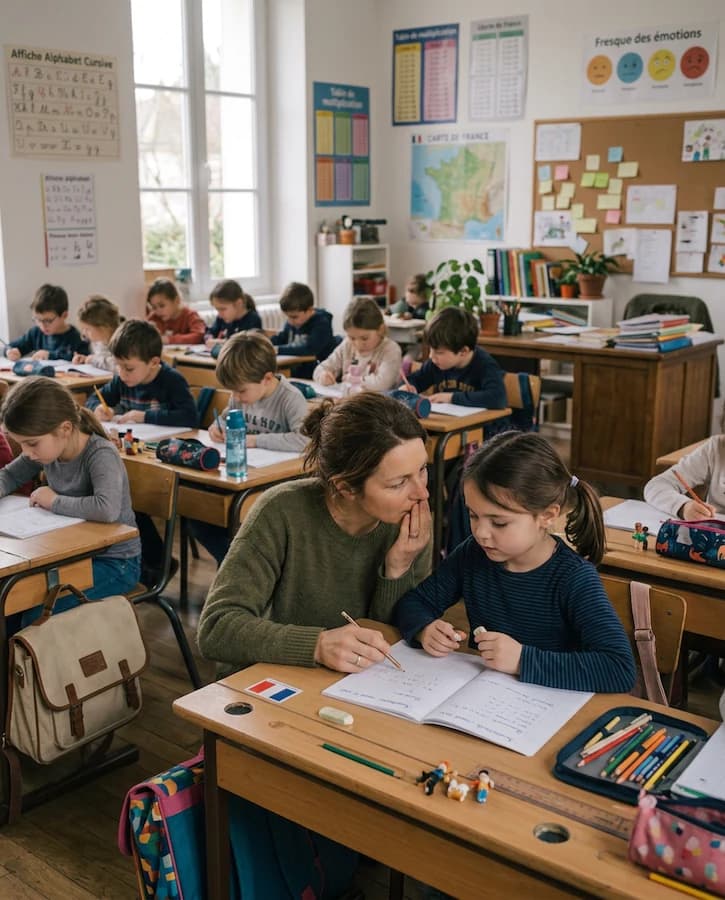
Observations often take on a different meaning depending on the time of day and school setting.
In the classroom: specific examples rather than a general impression
A difficulty may arise with a multistep instruction, group work, a change of teacher, or a less structured activity. Useful questions include: what did the adult see, when did it happen, and what support was available?
Learning, language, attention, sleep, noise, or relationships with other students can influence these moments.
Recess, the cafeteria, outings, and transitions
Less structured times sometimes provide different information: finding a group, understanding the rules of a game already underway, coping with cafeteria noise, waiting, changing classrooms, or dealing with a changed outing.
These opportunities are not the same for everyone. Missing information does not establish whether a difficulty is present or absent.
Starting the day, understanding instructions, and finding your way
Arriving in class, copying down homework, setting out materials, following a multistep instruction, or moving between subjects require different abilities. A child may know how to do the work but lose track when instructions are spoken, several adults talk, or they have to infer the priority. These observations do not automatically point to ASD.
It can help to ask whether the child gets started more easily with written instructions, an example, preparation time, one step at a time, or a discreet check-in. These observations describe conditions for success. They are often more useful in a conversation than a general impression that the child is inattentive, oppositional, or unmotivated.
- Exactly when does the difficulty arise?
- Was the instruction explicit, visible, and broken into manageable steps?
- What does the child do when they do not understand?
Group work, conversations, and unspoken rules
Group work may require joining a discussion already underway, dividing roles, understanding an unspoken expectation, negotiating an idea, or tolerating a less predictable pace. Some children find their place more easily when roles are defined; others prefer a chosen partner or need an adult to make the task more concrete.
Quiet participation does not necessarily indicate a social difficulty. A child may enjoy listening, feel uncomfortable in that group, fear making a mistake, or not have had a chance to speak. Conversely, a very active child may also need help noticing when a peer wants to change the subject. The school's examples and the young person's perspective complement each other.
- Were roles clearly assigned?
- Does the child do better in a pair, with a familiar peer, or with a specific task?
- Does the group give respectful, understandable feedback?
Recess, the cafeteria, sports, and outings: different settings
Less structured times may be enjoyable, difficult, or simply hard to observe, depending on age. Recess may involve joining a game, understanding a changing rule, moving away from noise, or finding an adult. In the cafeteria, noise levels, smells, waiting, or food choices may matter. During sports and outings, changes of location and safety instructions add other demands.
Avoid turning these moments into a social test. Some students choose quiet time, have more satisfying activities outside school, or do not have the same opportunities to participate. Useful information describes the situation, the participation the child wants, possible barriers, and respectful forms of support.
- Ask whether the child can reach a trusted adult when needed.
- Distinguish avoiding noise, needing a break, and unwanted isolation.
- Note moments that go well as well as difficult ones.
After school: coming home adds to the picture
A child may appear to hold things together all day and need silence, movement, time alone, food, or sleep on returning home. Others become angry during homework or can no longer talk about their day. These reactions may indicate accumulated demands, but also ordinary fatigue, a sleep disorder, a school difficulty, a long journey, or a relationship event.
A useful conversation does not ask the school to measure the child's internal effort. It can instead compare different times of day, transitions, demands before going home, and strategies that already work. The young person's perspective, when they wish to share it, matters so that an explanation is not built solely from adults' views.
- Allow a realistic transition before homework or evening activities.
- Identify what supports recovery without imposing a rigid routine.
- Discuss difficult days without reducing them to a behavior.
The school's perspective is valuable, but has limits
The school knows the child within a group, but does not see every rest period, relationships outside class, or developmental history. A change of teacher, a difficult classroom atmosphere, teasing, or a particular academic demand can change what is observed. The school's perspective is therefore one source among others, not a verdict.
When situations persist or interfere with participation, a family–school conversation can help choose one or two priorities: making instructions clearer, announcing a transition, considering a place within a group, planning time to settle, or involving a professional. A clinical assessment, when indicated, remains a separate process drawing on several informants.
- Share facts, not labels.
- Choose a concrete goal that can be reviewed.
- Respect confidentiality and the child's voice.
School situations change across grades and ages
In elementary school, classroom routines, group play, copying, the cafeteria, and transitions between activities may be central. In middle school, multiple teachers, classrooms, schedules, assessments, group projects, and movement between places broaden the demands. In high school, independence, future study and career choices, and peer relationships often take on more importance. These stages change the situations to discuss, not the child's worth.
A student may need different support in different subjects. A highly structured activity, an adult who explains things explicitly, or a kind peer can make a day much more accessible. Conversely, difficulty in just one subject may relate to a specific learning need, a relationship, or a period of overload. Generalizations are rarely helpful.
Moving from one level to another is a good time to revisit observed needs: what should be preserved, what should the new team understand, and how much independence does the young person want? This work can start before a major transition and focus only on what will genuinely help during the initial period.
- Adapt observations to age and the classroom's actual demands.
- Avoid automatically transferring support from one setting to every other setting.
- Prepare for school changes with the child when possible.
Choose a shared priority between family and school
When many situations are difficult, trying to solve everything at once can discourage the child and adults alike. A limited priority—understanding morning instructions, making group work easier, protecting the return from lunch, or supporting homework—allows a clear response to be tried and its actual benefits observed.
The priority should remain connected to the student's participation or well-being, not merely a behavior that bothers others. A break may help if it enables a return to the activity, but should not exclude the child over time. Support within a group should help the child contribute, not speak for them.
A simple follow-up can protect the relationship: the team and family agree on what they will observe, what they will share, and when they will review it. The child can take part according to their age. Their feedback may reveal that a well-intended measure feels too conspicuous or is not useful.
- Define an achievable, observable goal.
- Check the effect on the child, not only on adults.
- Plan to adjust, simplify, or remove support if it does not work.
Cereya Child Autism Test
A tool for describing situations without labeling the child
The Cereya questionnaire helps organize everyday observations from the past three months.
It neither confirms nor rules out ASD. It can support a conversation with the child, school, or a professional when that seems useful.
- a questionnaire completed with a parent or legal guardian
- room for the child's perspective, depending on their age
- observations organized by setting and area
- descriptive feedback, without a diagnosis
Initial summary included, with detailed analysis available afterward.
School and daily life
Observations often take on a different meaning depending on the time of day and school setting.
FAQ
Frequently Asked Questions
Why can the school's perspective help?+
The school sees the child in a group setting and can provide useful examples. Its observations complement the family's; they are not enough to establish a diagnosis.
Should we request the same accommodations for everyone?+
It is better to start with observable needs: understanding an instruction, preparing for a change, having time to recover, or making a group activity easier. Responses depend on the situation and the team.
What examples should I ask the school for?+
Brief, specific examples are most useful: time of day, type of instruction, group size, changes that occurred, the child's reaction, and support that helped. A broad comment such as “Everything is fine” or “It is difficult” can then be put into context.
Why does my child seem fine at school and then react strongly at home?+
A day can demand considerable attention, regulation, social adaptation, or tolerance of noise. But a reaction after school may also relate to sleep, transportation, homework, a conflict, or other factors. It is better to explore these possibilities without assigning a single cause.
Should I tell the teacher about the questionnaire?+
The report is a descriptive resource, and sharing it is the family's decision. It may be more useful to begin with a few concrete needs or ask for the team's observations. The school is not expected to confirm a clinical conclusion from a questionnaire.
Can an accommodation be tried without a diagnosis?+
Depending on the situation and the school's framework, simple adjustments can be discussed based on observed needs. Formal support programs have their own procedures. The goal is to find what supports participation, not to repeat the same solution for every student.
References and resources
This guidance is an educational synthesis of the recommendations and research cited below. It does not reproduce clinical criteria, tools, or protocols.
- Haute Autorité de Santé (2026) — Autism: new recommendations for infants, children, and adolescents.
- Haute Autorité de Santé (2026) — ASD: interventions and life pathways for infants, children, and adolescents.
- French Ministry of National Education — Schooling for students with special educational needs.
- éduscol — Schooling for students with autism spectrum disorder.
- Leifler, E., Carpelan, G., Zakrevska, A., Bölte, S. & Jonsson, U. (2021). Does the learning environment 'make the grade'? A systematic review of accommodations for children on the autism spectrum in mainstream school. Scandinavian Journal of Occupational Therapy, 28(8), 582–597. DOI: 10.1080/11038128.2020.1832145. PMID: 33078981.