Family–school dialogue
How to talk with the school about your child's needs
Discussing a child's school needs can be easier when starting with concrete situations: long instructions, transitions, recess, group activities, noise, or end-of-day fatigue.
The aim is to find together what supports participation, not ask the school to confirm a clinical hypothesis.
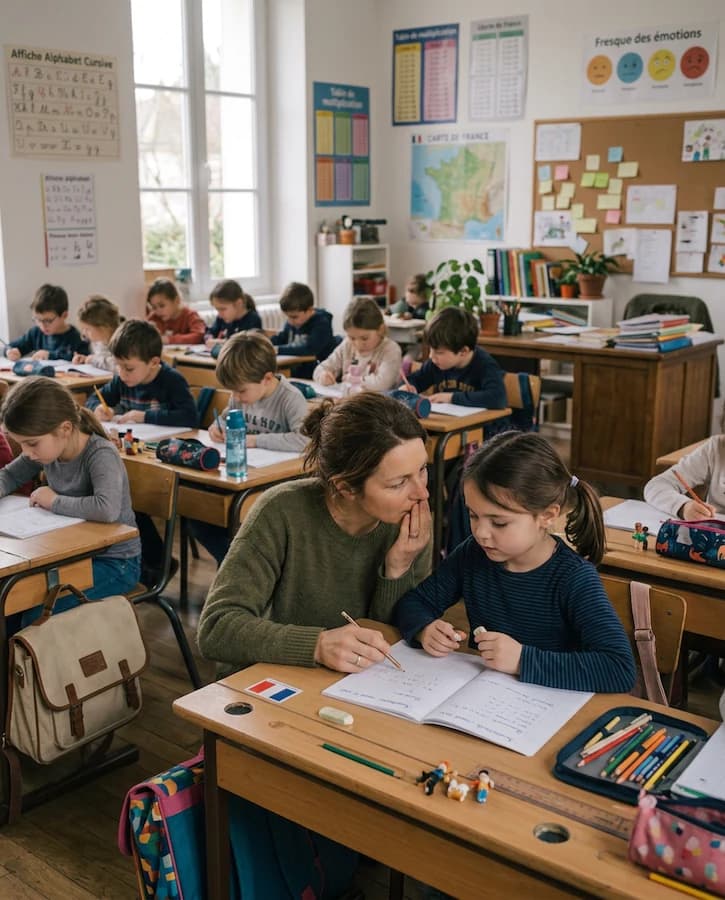
Talking with the school
A practical conversation can start with what already helps the child in a specific situation.
Start with what helps
‘They follow better when instructions are broken down’ or ‘Changes are more manageable with advance notice’ often opens dialogue more effectively than a general list of difficulties.
You can also ask what the team observes when things go well, helping identify resources that might work elsewhere.
Discuss adjustments rather than assuming them
Clearer instructions, announced transitions, breaks, group roles, or environmental adjustments may help depending on the class. Their relevance is discussed with the child, family, and team.
French frameworks such as PPRE, PAP, PPS, and other arrangements address different conditions and needs. Their possible use belongs in discussion with the relevant contacts.
Prepare a brief, concrete, balanced conversation
A school meeting is easier when it begins with two or three specific situations: long instructions, a transition, recess, group work, cafeteria noise, or evening fatigue. For each, families can describe home observations, ask about school context, and explain what already seems to help. The aim is understanding, not persuasion.
Beginning with resources often changes the conversation. A child who engages when the sequence is clear, enjoys a subject, or contributes willingly in a small group offers starting points that may transfer elsewhere. A meeting need not cover the child's whole history; one priority makes next steps more realistic and less stressful.
- Bring a few dated examples, not a list of behaviors.
- Name what works and what the child enjoys.
- Prepare one or two questions for the team.
Describe observable needs rather than requesting a label
‘They start more easily with written instructions’ or ‘She needs to know who will be in her group’ provides a more concrete starting point than ‘They struggle socially.’ It also leaves room for the team's observations. Needs may vary by class, adult, day, or fatigue; they do not define the whole child.
Needs may concern access to instructions, group participation, transitions, sensory surroundings, breaks, organization, or understanding a misunderstanding. They are not all equally urgent. The team and family can identify an adjustment most likely to improve everyday life without isolating the student or making them responsible for explaining everything.
- Connect a need with a specific situation.
- Avoid words that assume an intention or clinical cause.
- Ask how the child would prefer support to be offered.
Ask for examples and listen to the team's perspective
School staff can describe moments the family does not see: entering class, group instructions, teamwork, recess, lunch, sports, outings, or teacher changes. Simple questions help: ‘When does it happen?’, ‘With whom?’, ‘What helps?’, ‘Does it differ by activity?’ These avoid turning teachers into diagnosticians.
School may see something different from home. A structured day, trusting relationship, particular group, or recovery afterward at home may explain the difference. Rather than deciding who is right, families can use these contrasts to identify supportive settings and moments needing further attention.
- Ask for facts rather than an overall judgment of the student.
- Consider the classroom's actual constraints.
- Offer to share what was understood with the child afterward, according to age.
Try simple adjustments, then discuss them again
Clearer instructions, announced transitions, visual steps, assigned group roles, an agreed break signal, or a chosen classroom seat can be useful trials. They are neither treatment nor a guarantee. Their value depends on the child's experience, feasibility, and concrete effects on participation, comfort, and learning.
Brief follow-up keeps adjustments from remaining theoretical. Adults can agree to review after a few weeks or a particular activity: what did we try? What did the child notice? What did the team see? Should we continue, change, or stop? This preserves flexibility and avoids accumulating unnecessary measures.
- Try one support at a time when possible.
- Set a date or milestone for review.
- Do not maintain an adjustment that stigmatizes or does not help the child.
The French framework: discuss options without promising a scheme
In France, support schemes and accommodations may be discussed according to the student's situation and applicable procedures. PPRE, PAP, PPS, and other arrangements differ in purpose and eligibility. A guide cannot determine their relevance or replace appropriate school, health, or social care contacts.
Cooperation works better when it protects the child's dignity: avoid speaking as if they were absent, limit sensitive information to what is necessary, ask their opinion when possible, and do not use a diagnostic hypothesis to explain every behavior. The shared goal is more accessible participation, not a school label.
- Ask the school about relevant contacts and procedures.
- Share only information necessary for the chosen purpose.
- Keep a clear record of decisions and what remains to explore.
Keep dialogue alive without multiplying messages
Useful communication does not require parents and school to exchange every detail. A clear channel, reasonable frequency, and shared focus can protect the relationship. Depending on school practices, a brief targeted message, notebook, meeting, or scheduled check-in may suffice. Information should flow without burdening the child's or adults' everyday life.
Distinguish urgent information from observations to revisit later. Safety, health, violence, or bullying calls for an appropriate response without waiting for the next review. For other matters, gathering examples and useful supports avoids treating each day as confirmation or rejection of a hypothesis.
As the young person grows, communication can change. A middle or high school student may want to receive a summary, write part of a message, or decide what can be discussed. This should not turn them into the coordinator: adults remain responsible for cooperation and protection.
- Choose a contact frequency suited to the actual situation.
- Reserve immediate alerts for matters that cannot wait.
- Gradually involve the young person in what is shared about them.
During the meeting: maintain cooperation
A meeting can be more productive when everyone knows the topics: one or two needs, each person's observations, possible adjustments, and how to review them. Parents can begin by listening before sharing questions. Teachers can explain classroom constraints and moments when the student already has resources.
When views differ, restating a situation helps avoid confrontation. ‘At home, they need a long time after school; what do you notice in the final classes?’ opens a more precise conversation than ‘The school sees nothing.’ Disagreement may reflect different contexts rather than a lack of goodwill on either side.
Recording decisions, responsibilities, and when adults will speak again may help. The record need not be long. It reduces misunderstandings and avoids making the child carry messages alone between home and school. Depending on age, the child can be informed appropriately or join part of the conversation.
- Use wording focused on facts and needs.
- Ask for clarification when school terminology is unclear.
- Plan realistic, proportionate follow-up.
The child's role in decisions that affect them
Children should not carry sole responsibility for accommodations, but can often say what helps or feels uncomfortable. An elementary student might choose between two ways to ask for help; an adolescent may want information kept private or take part in defining a goal. Their input makes adjustments more realistic.
Adults should avoid speaking as if a present child were absent or sharing an unexplained clinical hypothesis in front of them. Simply explaining what is being discussed, why, and with whom protects trust. Sensitive topics can also have separate discussion time, with an explanation to the young person of what will later be shared.
Respecting the child's voice does not mean adults stop protecting health, safety, or education. It means explaining decisions and seeking their perspective. This approach can reduce anxiety, improve cooperation, and help the young person gradually develop independence.
- Ask what the child most wants to change.
- Clearly explain what information will be shared with school.
- Adapt participation to age, understanding, and safety.
Cereya Child Autism Test
A tool for describing situations without labeling the child
The Cereya questionnaire helps organize everyday observations from the past three months.
It neither confirms nor rules out ASD. It can support a conversation with the child, school, or a professional when that seems useful.
- a questionnaire completed with a parent or legal guardian
- room for the child's perspective, depending on their age
- observations organized by setting and area
- descriptive feedback, without a diagnosis
Initial summary included, with detailed analysis available afterward.
Talking with the school
A practical conversation can start with what already helps the child in a specific situation.
FAQ
Frequently Asked Questions
Should we wait for a diagnosis before talking to school?+
You can start with specific situations and observable needs without waiting for a label. School staff can describe what they see and what is possible within their setting.
Is there one solution for every student?+
Accommodations and support arrangements depend on the student's situation and the school framework. Discussion with the team avoids promising a standardized solution that would not suit everyone.
Should we wait for a diagnosis before requesting a conversation?+
No. You can discuss observable situations and needs without a clinical conclusion: clearer instructions, advance notice of transitions, or recovery time, for example. School staff can share observations and discuss what is feasible within their setting.
How can we avoid turning the conversation into a list of difficulties?+
Starting with what helps and when the child participates well creates a more balanced discussion. A difficulty can then be connected with context and possible support rather than a label or a general expectation of the student.
What simple adjustments can be discussed?+
Depending on the situation, options may include clearer instructions, advance notice of transitions, a chosen group role, a break, a different seat, or visible information. Their relevance depends on the child, class, and school's possibilities; they should be reviewed.
Should we discuss formal school support plans?+
French frameworks such as PPRE, PAP, and PPS address different situations and procedures. They can be discussed with appropriate contacts when relevant, without presenting them as automatic responses. An observed need alone does not establish eligibility for a particular scheme.
Should we mention possible autism to the school?+
There is no single answer. Families can first discuss concrete situations and needs that would support participation. When sharing more personal information, consider its purpose, who needs it, and, depending on age, what the child wants to know or keep private.
References and resources
This guidance is an educational synthesis of the recommendations and research cited below. It does not reproduce clinical criteria, tools, or protocols.
- Haute Autorité de Santé (2026) — Autism: new recommendations for infants, children, and adolescents.
- Haute Autorité de Santé (2026) — ASD: interventions and life pathways for infants, children, and adolescents.
- French Ministry of National Education — Schooling for students with special educational needs.
- éduscol — Schooling for students with autism spectrum disorder.
- Leifler, E., Carpelan, G., Zakrevska, A., Bölte, S. & Jonsson, U. (2021). Does the learning environment 'make the grade'? A systematic review of accommodations for children on the autism spectrum in mainstream school. Scandinavian Journal of Occupational Therapy, 28(8), 582–597. DOI: 10.1080/11038128.2020.1832145. PMID: 33078981.